
Anúncios
Our minds constantly construct reality from fragments of sensory input, filtering billions of data points through unique neural pathways that bend, twist, and reshape what we believe to be objectively true.
🧠 The Architecture of Perceived Reality
Every moment of our waking lives, we’re surrounded by what we call reality. But what if everything we experience is merely a sophisticated interpretation? The human brain processes approximately 11 million bits of information per second, yet our conscious mind can only handle about 40 to 50 bits during that same timeframe. This massive discrepancy reveals a startling truth: most of what shapes our perceived world operates beneath conscious awareness.
Anúncios
Perception isn’t a passive reception of external stimuli. Instead, it’s an active construction process where our brains predict, fill gaps, and create coherent narratives from incomplete information. This predictive processing means we’re essentially hallucinating our reality all the time, with sensory input merely keeping our hallucinations in check.
Neuroscientists have discovered that our brains use prior experiences, cultural conditioning, and emotional states to literally shape what we see, hear, and feel. The unseen mechanisms of perception operate like invisible puppet masters, pulling strings that determine which aspects of objective reality make it through to our conscious experience.
Anúncios
The Filter Bubble Inside Your Skull
Long before social media algorithms created personalized information bubbles, our brains were already masters at filtering reality through deeply personal lenses. Cognitive biases—systematic patterns of deviation from rationality—act as built-in distortion mechanisms that warp our perception in predictable ways.
Confirmation bias ensures we notice information that aligns with existing beliefs while overlooking contradictory evidence. The availability heuristic makes recent or emotionally charged events seem more probable than they actually are. Meanwhile, the fundamental attribution error causes us to judge others by their actions but ourselves by our intentions.
These aren’t bugs in the system—they’re features developed through millions of years of evolution. Our ancestors survived not by perceiving reality with perfect accuracy, but by making fast, good-enough judgments that kept them alive. The cost of this efficiency? A perpetual distortion field that bends reality around our preconceptions.
Cultural Lenses and Reality Tunnels
Culture adds another layer of distortion to perception. People from different cultural backgrounds literally see the world differently. Research has shown that Western individuals tend to focus on focal objects in visual scenes, while East Asian observers pay more attention to contextual relationships and backgrounds.
Language shapes thought in profound ways. Speakers of languages with gendered nouns unconsciously associate masculine or feminine qualities with objects based on grammatical gender. Communities with different color vocabularies actually perceive color boundaries differently. These aren’t trivial differences—they’re fundamental alterations in how reality appears to conscious awareness.
⚡ When Perception Betrays Physical Reality
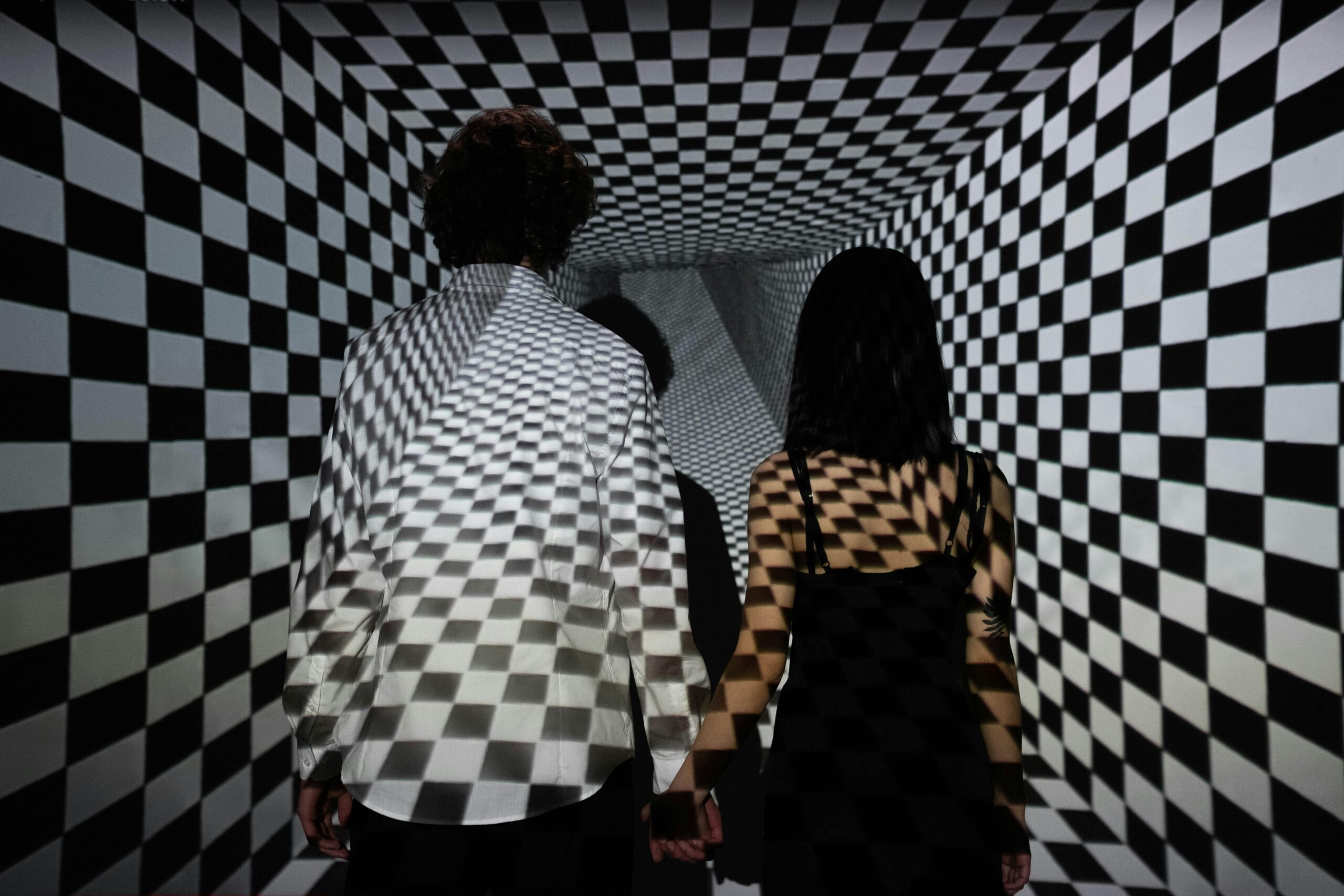
Optical illusions offer fascinating windows into the gap between objective reality and subjective experience. The famous checker shadow illusion demonstrates how context completely overrides actual sensory data. Two squares that are physically identical shades appear dramatically different because our visual system accounts for shadows and lighting.
The McGurk effect shows similar distortions in auditory perception. When visual information about mouth movements contradicts the actual sounds being produced, our brains create a third, phantom perception that neither matches what we see nor what we hear. This multisensory integration happens automatically, beyond conscious control.
These aren’t quirks or failures—they reveal the fundamental nature of perception. Our brains don’t simply record reality; they interpret it based on assumptions about how the world works. Most of the time, these assumptions serve us well. But they also create systematic blind spots and illusions that we can’t overcome through willpower alone.
The Invisible Gorilla and Selective Attention
Perhaps the most humbling demonstration of perception’s limitations comes from studies on inattentional blindness. In the famous invisible gorilla experiment, participants watching a video of people passing basketballs completely failed to notice a person in a gorilla suit walking through the scene.
This isn’t about stupidity or poor observation skills. It reveals that attention acts as a spotlight, illuminating only a small portion of available sensory input. Everything outside that spotlight might as well not exist. We don’t experience our perception as limited because we can’t perceive what we’re not perceiving—creating a perfect illusion of comprehensive awareness.
🌊 Emotion as Reality’s Distortion Field
Emotions don’t just color our interpretation of events—they fundamentally alter what we perceive. When anxious, we detect threats that others miss. When depressed, we notice failures and overlook successes. When in love, we perceive qualities in others that mysteriously vanish when the infatuation fades.
The emotional state you’re in right now is filtering reality through a particular lens, emphasizing certain features while minimizing others. This creates a feedback loop: emotions shape perception, which generates thoughts that reinforce emotions, which further distort perception. Breaking this cycle requires recognizing that our current emotional state is altering the reality we experience.
Studies on mood-congruent memory show that emotional states affect not just current perception but also which memories surface. When sad, we more easily recall other sad events, creating a distorted view of our personal history. Our autobiography constantly rewrites itself based on present feelings, making the past as fluid and unreliable as the present.
The Social Construction of Shared Illusions
Individual perception is strange enough, but collective perception creates even more complex illusions. Social proof—the tendency to assume that if many people believe something, it must be true—can cause entire societies to share elaborate misperceptions.
Financial bubbles demonstrate this perfectly. During speculative manias, collective perception shifts so that wildly overvalued assets seem reasonably priced. Tulip bulbs in 17th-century Netherlands, dot-com stocks in the late 1990s, or cryptocurrency in recent years—each attracted intelligent people who genuinely perceived value where little existed.
These aren’t cases of mass deception by a few manipulators. Instead, they’re emergent properties of social perception where individual biases amplify through networks, creating shared reality tunnels that entire communities inhabit simultaneously.
Media and the Manufactured Consensus
Modern media environments accelerate and amplify perceptual distortions. The stories that dominate news cycles shape not just what we think about but what we believe is important, common, or threatening. Availability bias means that the issues we hear about constantly seem more prevalent than they actually are.
The agenda-setting function of media doesn’t tell us what to think, but it powerfully influences what to think about. By making certain topics omnipresent and others invisible, media creates perceptual landscapes where some possibilities seem obvious while others become literally unthinkable.
🔍 Memory’s Unreliable Testimony
If perception distorts present reality, memory compounds the problem by distorting the past. Every time we recall a memory, we reconstruct it rather than playing back a recording. This reconstruction process introduces new distortions, blending current beliefs and emotions with fragments of actual experience.
Research by Elizabeth Loftus and others has demonstrated how easily false memories can be implanted through suggestion. People confidently recall detailed events that never happened, complete with sensory details and emotional resonance. Eyewitness testimony, once considered the gold standard of evidence, now appears alarmingly unreliable.
This isn’t about having a “bad memory.” It’s the fundamental nature of how memory works. Our autobiographical past is a story we continuously revise, not a documentary we replay. The person you were ten years ago exists now only as a narrative reconstruction, filtered through everything that’s happened since.
Breaking Through the Perceptual Veil
Understanding that perception creates illusions might seem depressing—if we can’t trust our senses, memories, or judgments, how can we navigate reality? But recognizing these limitations is actually liberating. It’s the first step toward developing metacognition—thinking about thinking—that allows more accurate perception.
Mindfulness practices help create space between stimulus and interpretation. By observing thoughts and perceptions without immediately accepting them as truth, we can notice the gap between reality and our experience of it. This doesn’t eliminate perceptual distortions, but it makes us less likely to mistake our particular hallucination for objective truth.
Scientific thinking provides another corrective tool. The scientific method evolved specifically to overcome human perceptual and cognitive biases. Controlled experiments, blind observations, and statistical analysis help reveal truths that perception alone would miss or distort. Science isn’t perfect, but it’s our most reliable method for transcending individual perceptual limitations.
Cognitive Humility and Multiple Perspectives
Perhaps the most practical response to perceptual distortion is cultivating intellectual humility. Recognizing that our perspective is inherently limited and biased makes us more open to alternative viewpoints. What we perceive as obviously true might look completely different from another vantage point.
Actively seeking perspectives that challenge our perceptions creates opportunities to triangulate toward more accurate understanding. This doesn’t mean accepting all viewpoints as equally valid, but rather recognizing that our initial perception is never the complete picture.
💡 Living Wisely in a World of Illusions
The recognition that perception shapes reality into a world of illusions need not lead to paralysis or nihilism. Instead, it offers an opportunity for deeper wisdom. When we understand how easily our minds bend reality, we become less certain of our judgments and more curious about alternative possibilities.
This understanding has practical implications. In conflicts, recognizing that others genuinely perceive situations differently—not because they’re dishonest, but because perception works that way—can foster empathy and more productive dialogue. In decision-making, awareness of cognitive biases can prompt us to seek objective data rather than trusting gut feelings.
The most profound implication might be existential. If our experience of reality is largely constructed rather than directly perceived, then we have more agency in shaping that experience than we typically assume. By adjusting attention, questioning assumptions, and deliberately cultivating certain mental habits, we can influence the reality we inhabit.
The Paradox of Perceptual Awareness
Here’s the strange paradox: becoming aware that perception creates illusions doesn’t free us from those illusions. Even after learning about the checker shadow illusion, the squares still look different. Even knowing about confirmation bias doesn’t make contrary evidence suddenly appear unbiased.
But this awareness does something subtler and more valuable. It introduces doubt at the right moments, creates pauses for reflection, and opens space for alternative interpretations. We don’t escape the perceptual prison—we learn to see the bars, and in seeing them, gain some freedom to reshape them.
The unseen forces that twist reality into personal illusions will never fully reveal themselves. They operate in the blind spots of consciousness, beneath the threshold of awareness. But by understanding their general mechanisms and remaining alert to their effects, we can navigate closer to truth, even if perfect objectivity remains forever out of reach.
In the end, shaping the unseen means recognizing our role as active participants in constructing reality rather than passive observers recording it. This shift in understanding—from perception as reception to perception as creation—represents one of the most important insights available to human consciousness. The world you experience is not the territory itself but a map drawn by neural algorithms optimized for survival rather than truth. Knowing this changes everything, even as everything appears to remain the same.
